Rust, How Blooprint's Solo's Journey IV Turned 14 Days Into a Five-Hour Movie
You can order the same kind of articles for your own video to boost it on YouTube and Google. Just message the Telegram bot @sat_sit_bot. Articles with your video embedded are written and posted by the bot itself — on popular topical sites (no ads). Your first 50 articles are free.
· based on the channel Blooprint
Key takeaways
- Blooprint's Solo's Journey IV: Apex Survivor covers 14 days of solo Rust on a single wipe.
- The finished movie runs almost five hours and is split into 12 chapters plus an intro and ending.
- Blooprint reports 300+ hours of filming and editing behind the project.
- A dedicated site, solosjourneytracker.com, lets viewers enter a timestamp and see progress at that point.
- The video marks 2.5 million subscribers on the Blooprint channel.
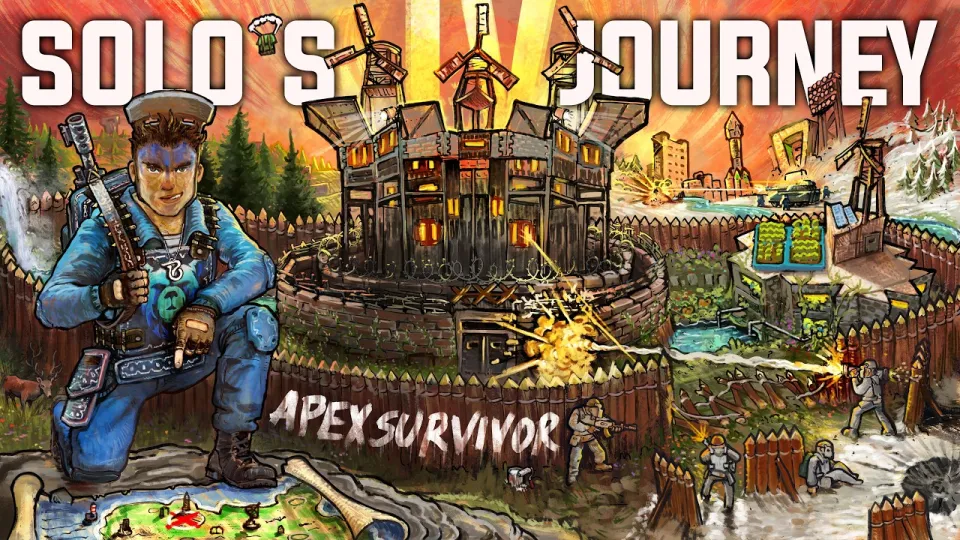
Rust is a survival game where a solo player starts naked on a beach with a rock and must build a base, secure resources and defend everything against groups — and Blooprint's Solo's Journey IV: Apex Survivor is the clearest illustration of that grind, condensing 14 days of solo play on one wipe into a single movie of almost five hours. The project was filmed and edited by Blooprint himself over 300+ hours, and every stage of the run is mapped on the Solo's Journey tracker, where you type in a timestamp and immediately see the player's progress at that moment.
What Solo's Journey IV actually is
Solo's Journey IV is a long-form Rust movie rather than a highlight reel: it documents one solo survivor's full arc across a 14-day wipe, from first spawn to endgame. The structure is deliberate — an introduction, twelve numbered chapters and a closing segment — so the run reads as a story with escalation instead of a random montage of fights. Blooprint describes it as a rare kind of project on the channel, made with pride to mark 2.5 million subscribers, and the runtime reflects that ambition: the video sits just under five hours, which is why viewers treat it as something to watch in parts rather than in one sitting.
The scale is the point. Most Rust content compresses a wipe into 15–30 minutes; here the slow parts stay in — the farming, the base building, the quiet stretches where nothing happens and the next decision matters.
The chapter structure, start to finish
The movie is divided into 14 segments, which makes it easy to watch in sessions. The chapters are:
- Introduction
- Chapter 1
- Chapter 2
- Chapter 3
- Chapter 4
- Chapter 5
- Chapter 6
- Chapter 7
- Chapter 8
- Chapter 9
- Chapter 10
- Chapter 11
- Chapter 12
- The End
Chapters 1 through 3 run roughly 20–25 minutes each, the middle chapters stretch past half an hour, and the final third of the movie carries the heaviest material — late-wipe raids, revenge and the closing fights. The tracker site exists precisely because of this length: if you resume mid-chapter, entering your timestamp shows what the survivor owns, where the base stands and what has already happened.
What a 14-day solo wipe demands in Rust
Surviving two weeks alone in Rust is a resource-management problem before it is a combat problem. A solo has no one to share the grind with, so every scrap, every sulfur node and every component is earned at full price, and every hour spent farming is an hour not spent defending. The practical priorities that separate a 14-day solo run from a two-day one:
- Base placement over base size. A modest, well-placed base that survives the wipe beats an ambitious compound that paints a target on day three.
- Redundancy. Multiple smaller bases and hidden stashes mean a single raid does not end the run.
- Farming discipline. Sulfur and scrap budgets decide whether you can raid back or only rebuild.
- Timing. Monuments, cargo ship and oil rig are contested; going late or early is often worth more than going prepared.
- Not fighting every fight. A solo who trades kills evenly loses the wipe; a solo who avoids bad fights keeps the base.
That last point is where most solo attempts collapse, and it is the thread the movie follows: patience, then a decisive strike.
Base building and the "farm base" debate
One of the recurring discussions around the movie is base design — specifically whether a compact, non-meta layout can carry a long solo wipe. The answer the run demonstrates is yes, with caveats: an efficient farm base with tight loot rooms and a cloning setup for plants keeps food, cloth and low-grade fuel flowing without constant monument trips. Cloning is a quiet multiplier — a small greenhouse producing berries and hemp removes two entire farming loops from the daily routine, which for a solo is worth more than an extra turret.
A triangle-heavy core, storage spread across rooms and a layout that forces raiders to spend more explosives than the loot is worth are the fundamentals. It is not the strongest base on the server. It does not need to be — it needs to be the least attractive target relative to its neighbours.
Raids, revenge and server politics
Long wipes generate stories that short ones cannot, and the movie's back half is built on them. Solo Rust is not only PvP mechanics; it is reading a server's social map — who is fighting whom, which clan is expanding, which neighbour is worth keeping alive as a buffer. Revenge raids, alliances of convenience and the occasional neighbourly goodwill all appear because two weeks is long enough for relationships to form and break.
For players watching to learn, the takeaway is that information beats aim over a full wipe. Knowing a clan's online hours, their door count and their loot habits is what makes a solo raid profitable rather than a donation of explosives.
Common questions from viewers, answered
Is it worth watching in one sitting? Almost nobody does. The video is designed to be consumed in chapters, and the tracker exists to support exactly that habit — pause, come back, type your timestamp, continue.
Does it require Rust experience to follow? No, but it rewards it. Newcomers get a clear picture of progression; players with a few hundred hours get the decision-making behind each step.
Is this representative of normal solo Rust? Partly. The skill level is far above average, but the problems — groups, offline threats, resource scarcity, time pressure — are the same ones every solo faces.
What makes it different from a highlight montage? Continuity. A montage shows the wins; this shows the hours between them, including the setbacks that make the wins mean something.
Useful links
- Solo's Journey tracker — enter a timestamp, see progress at that point.
- Blooprint Youtooz vinyl figure — limited run, available until October 27, 2026.
- Blooprint mousepads and playmats — available until January 3, 2027.
- Hires Studio — animated intro.
- Veys — thumbnail art.
Final thoughts
Solo's Journey IV works because it treats Rust as a season of television rather than a match: 14 days, 12 chapters, one survivor, and a runtime that most creators would consider commercial suicide. Blooprint's editing carries the slow stretches, and the tracker turns a five-hour video into something you can actually navigate. If you want to see what a solo wipe looks like when nothing is cut out, start with the Solo's Journey tracker and work through the chapters at your own pace. The channel Blooprint has built this format over several entries, and this one is the most complete version of it so far.
Questions & answers
How long is Blooprint's Solo's Journey IV: Apex Survivor?
The movie runs just under five hours and is split into an introduction, twelve numbered chapters and a closing segment. Most viewers watch it across several sessions, which is why the companion tracker site lets you enter a timestamp and see progress at that exact point.
How many days does the solo run cover?
It covers 14 days of solo Rust on a single wipe. Blooprint also states that filming and editing the project took well over 300 hours, which is why the result is presented as a movie rather than a standard gameplay series.
Does a non-meta base design work for a long solo wipe?
It can, provided the layout is efficient rather than large. A compact core, spread-out storage and a plant cloning setup reduce daily farming loops, and the base only needs to be a less attractive raid target than its neighbours — not the strongest structure on the server.
Do I need to know Rust to enjoy the video?
No. The progression from beach spawn to endgame is explained through the action itself, so newcomers can follow the arc. Experienced players get more out of it, since the decision-making around farming, monuments and raid timing is where most of the substance sits.
Source: Rust - A Solo's Journey IV: Apex Survivor (Movie) · Markdown version